PMLB
The Penn Machine Learning Benchmarks (PMLB) is a curated collection of benchmark datasets for evaluating machine learning methods. HGP is evaluated on the binary classification datasets in the suite.
Data preparation
The preprocessing script lives at scripts/preprocess/pmlb_preprocess.py.
It fetches a named dataset with the pmlb package and writes it to the data folder as an HDF file.
python scripts/preprocess/pmlb_preprocess.py breast_cancer --data_path data
This writes data/breast_cancer.hdf.
The list of binary classification datasets comes from the PMLB summary table. The same query is used by the batch runner to decide which datasets to process.
from pmlb.dataset_lists import df_summary

binary_datasets = df_summary[df_summary["n_classes"] == 2.0]["dataset"].tolist()
Warning
Some datasets listed in older PMLB summaries are no longer available, because they were removed as duplicates. Fetching such a dataset raises an error. Skip the missing datasets and continue with the rest.
Running a benchmark
Benchmark the Boolean GP on a single preprocessed dataset with scripts/run_benchmark.py.
python scripts/run_benchmark.py --data_path data/breast_cancer.hdf
See python scripts/run_benchmark.py --help for the full list of options.
Hyperparameter tuning
Tune a single dataset with the Optuna script. The study name keeps trials grouped, and artifacts are written to the artifact directory.
python scripts/optuna_hypertuning.py \
    --data_path data/breast_cancer.hdf \
    --study_name pmlb_breast_cancer \
    --n_trials 25 \
    --max_n_trials 25 \
    --n_runs 5 \
    --n_folds 3 \
    --artifact_dir ./artifacts
Running on all datasets
The scripts/run_on_pmlb.py script runs the Optuna tuning across every binary classification dataset.
It fetches the dataset names, builds one optuna_hypertuning.py command per dataset, and runs them in parallel.
python scripts/run_on_pmlb.py --n_jobs 4
The --n_jobs argument sets how many datasets are processed at the same time.
Preprocessing is not required beforehand.
When a dataset file is missing, optuna_hypertuning.py downloads it from PMLB and writes the HDF file before tuning.
Results on PMLB
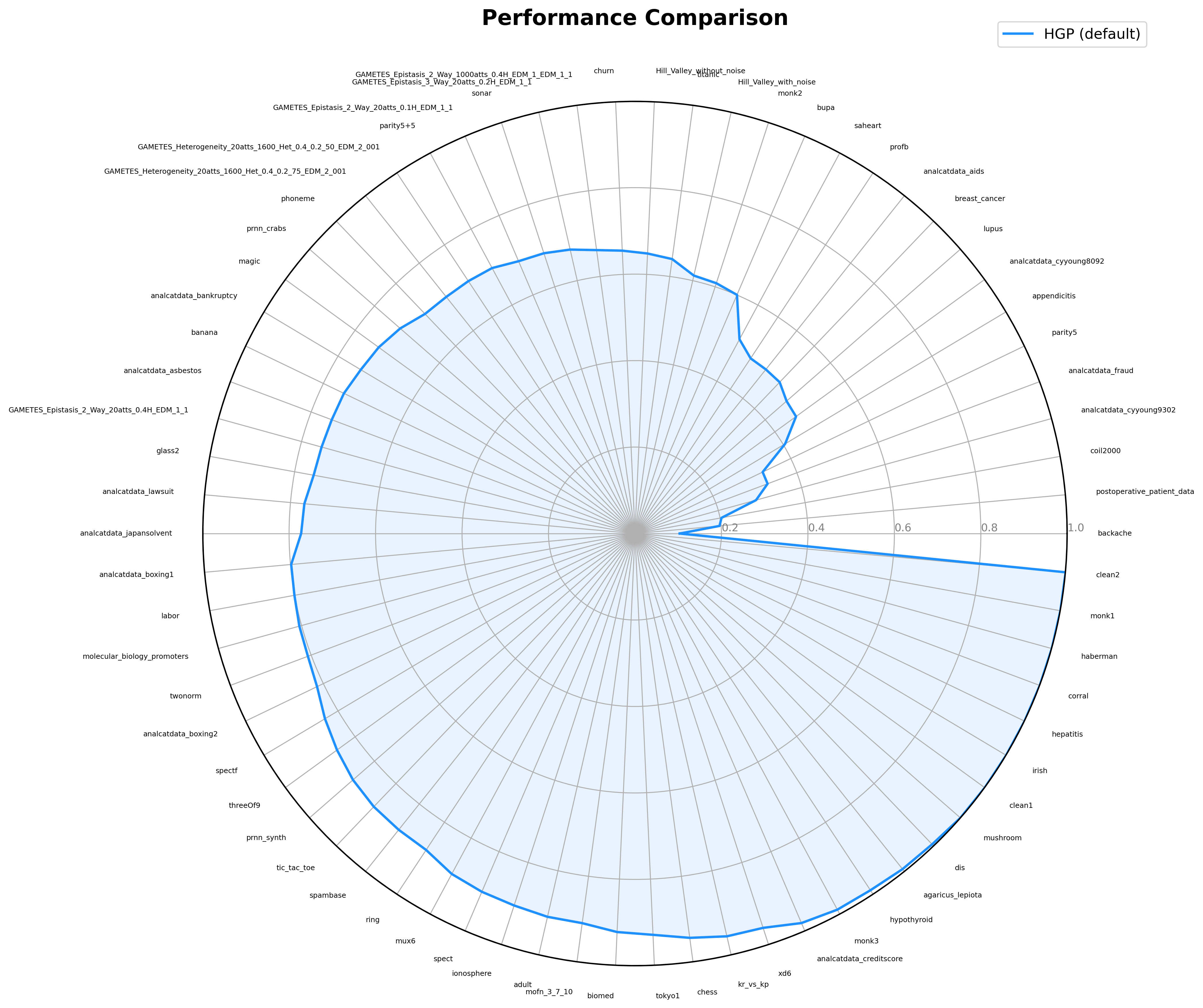
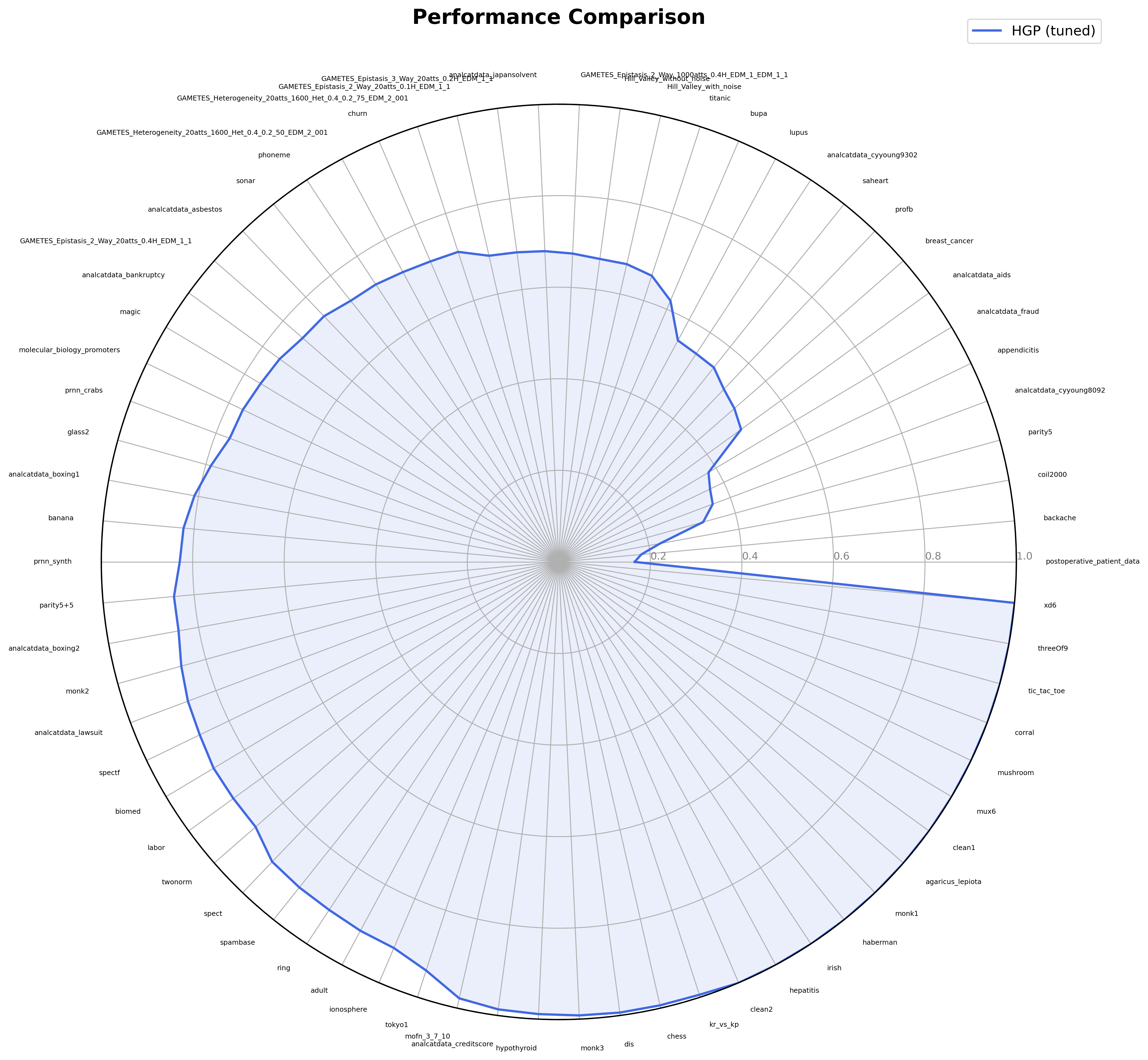
This case study evaluates HGP on 70 binary classification datasets from PMLB. We compare two HGP variants against two interpretable baselines.
The HGP variants are:
- HGP (default): run with
run_on_pmlb.py --model gp_default --num_epochs 10000, using the library defaults. - HGP (tuned): run with
run_on_pmlb.py --model gp_tuned, which tunes each dataset with the Optuna script for 100 trials using the standard Optuna hyperparameter search.
The baselines are:
- Decision trees from scikit-learn1, an interpretable tree-based classifier.
- BoolXAI2, a local-search method that also evolves expressive boolean formulas.34
All results use F1 score on the held-out test set, averaged across runs. Each comparison counts, per dataset, which method reached the best (or tied for best) score.
Per-dataset scores
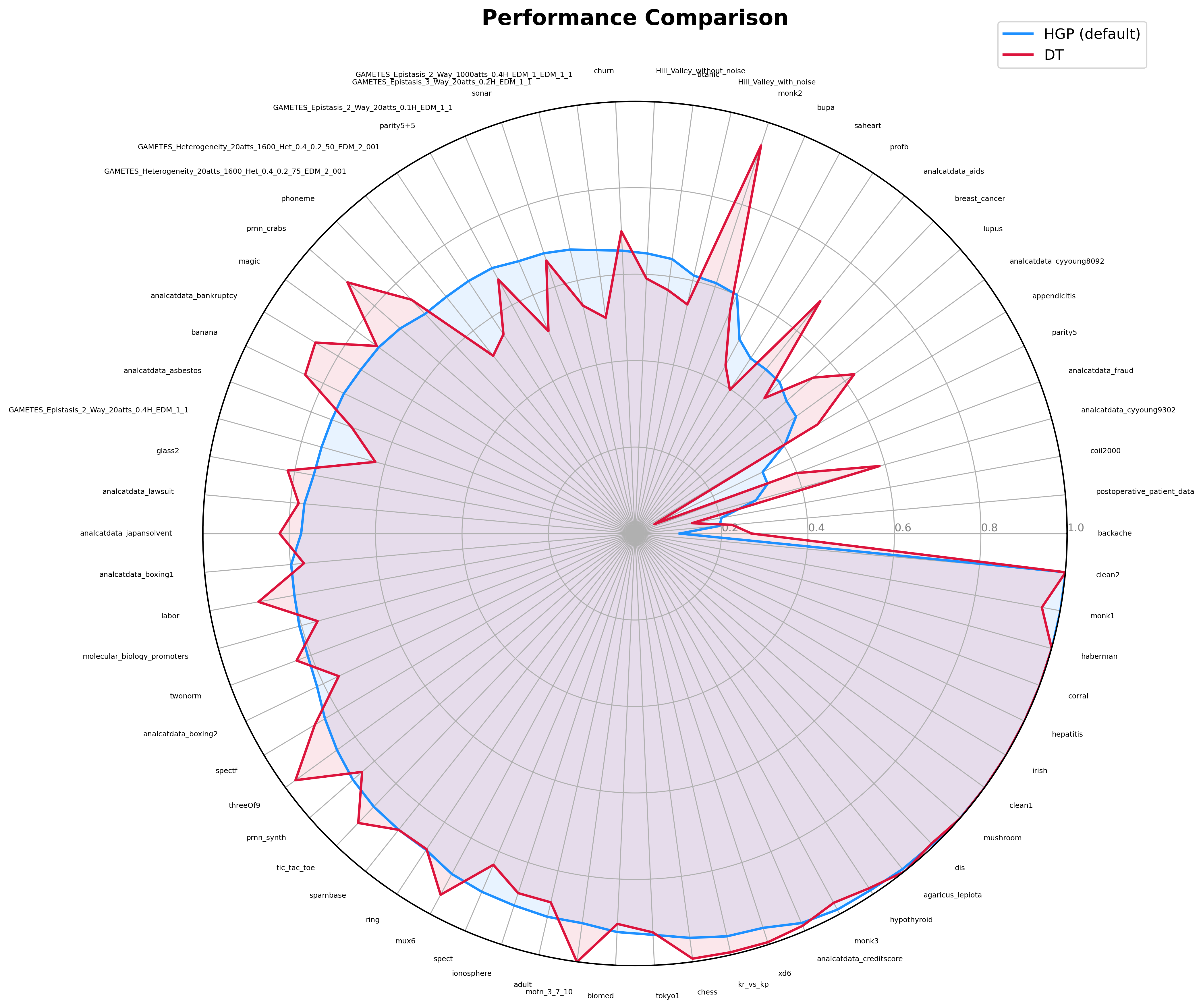
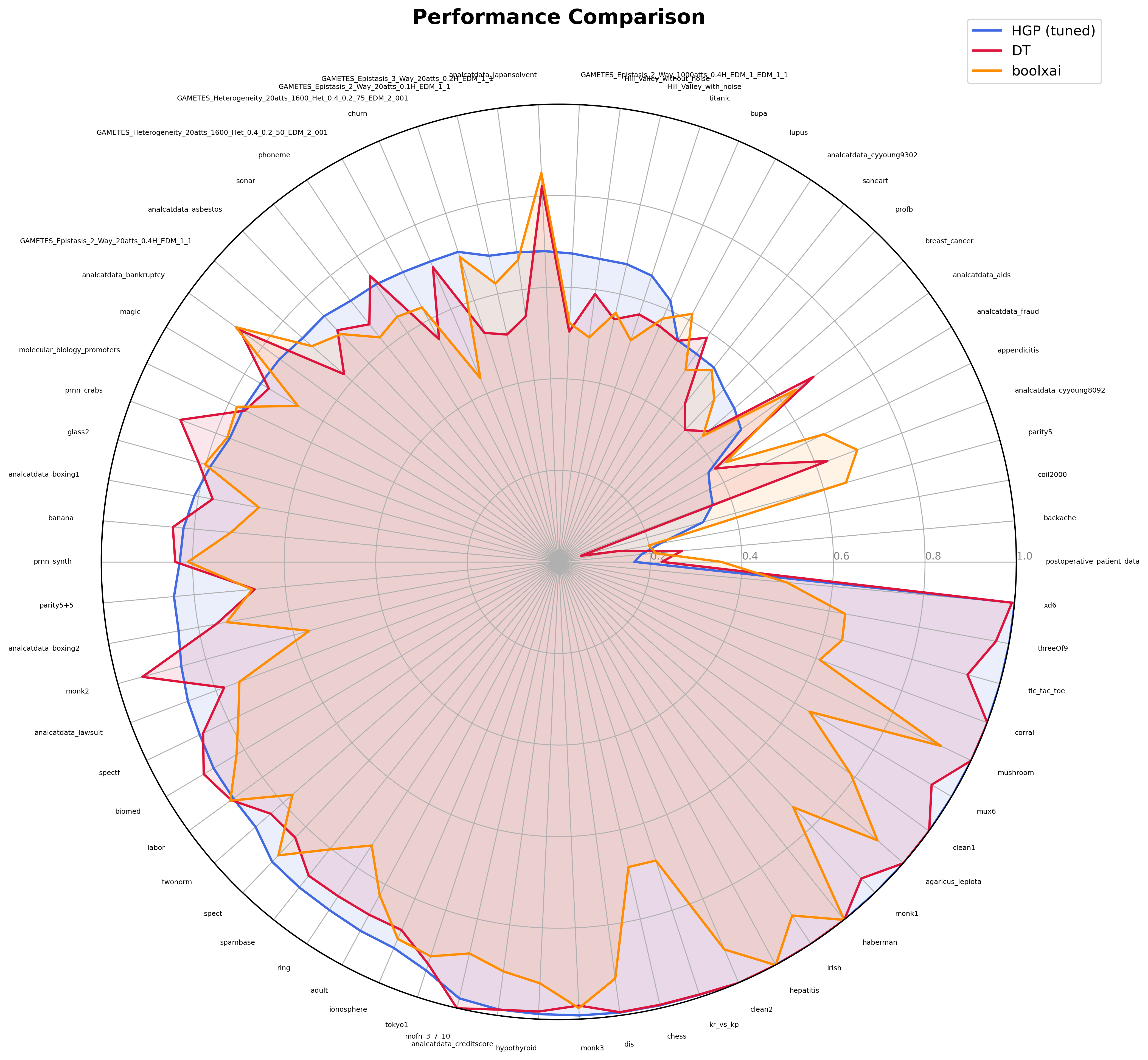
The score of each variant across all datasets.
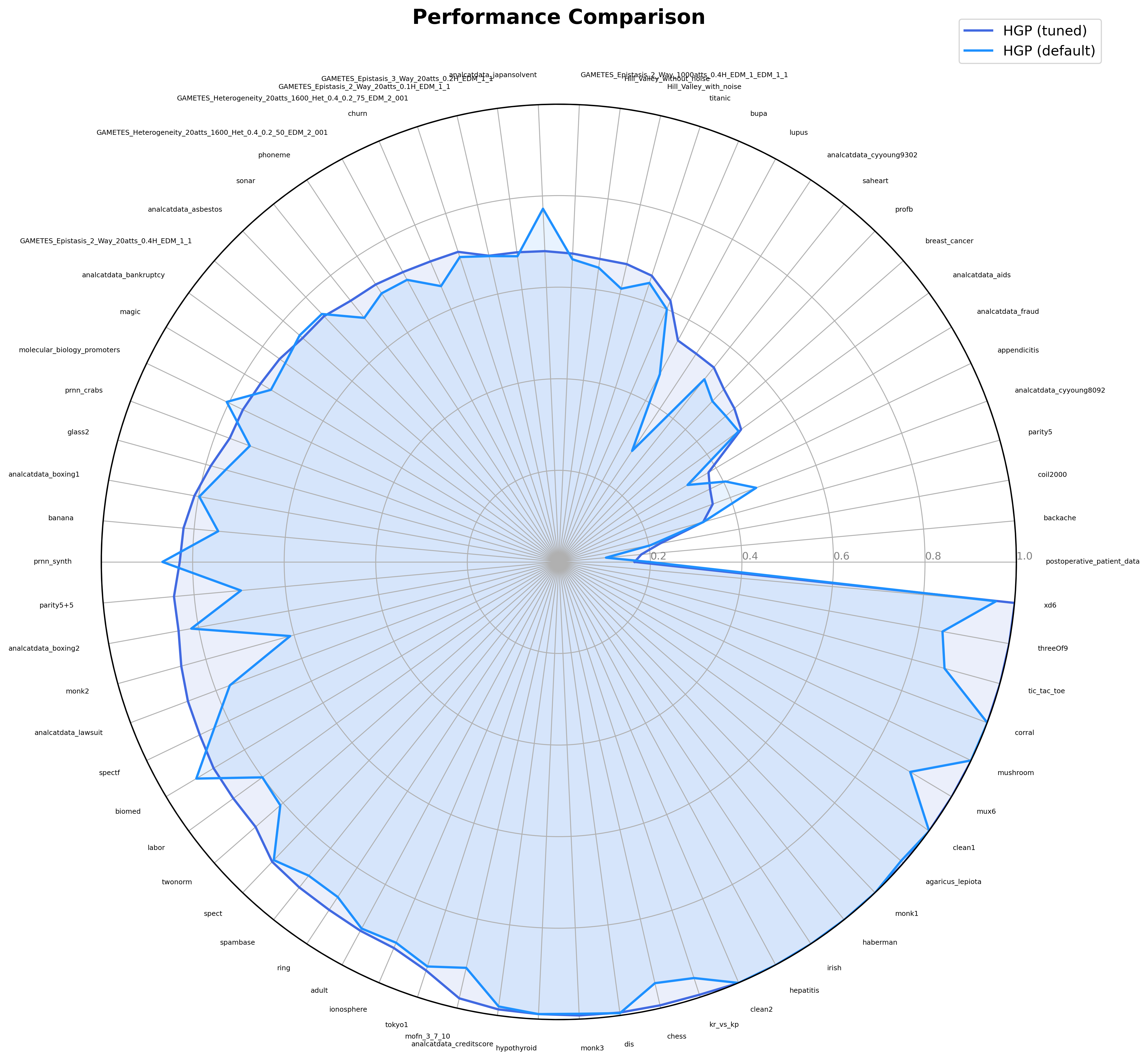
Tuned vs default
Tuning helps on most datasets. HGP (tuned) was best or tied on 59 of 70 datasets, and HGP (default) on 19 of 70.
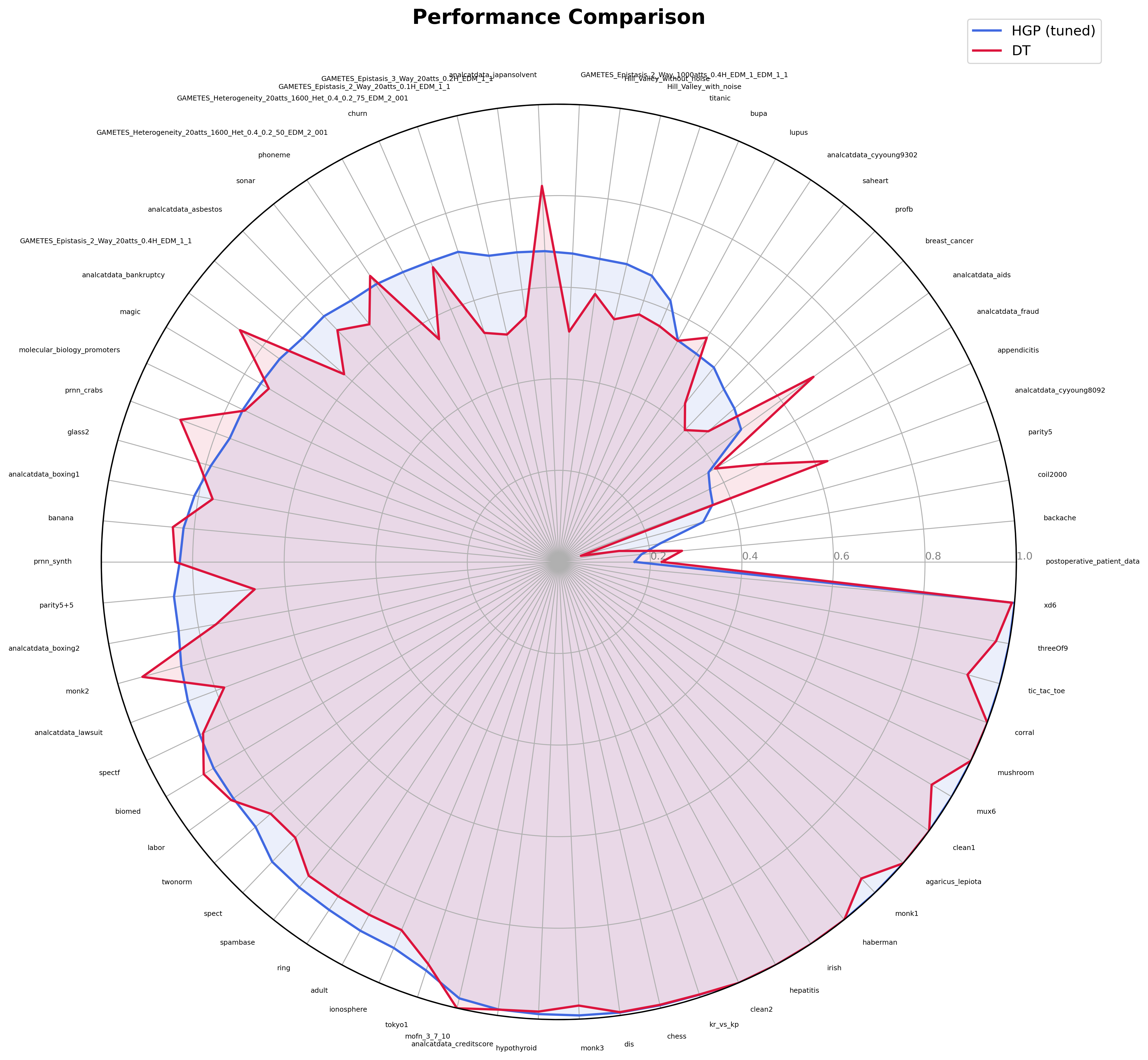
Tuned vs decision tree
HGP (tuned) outperforms the decision tree baseline. HGP (tuned) was best or tied on 51 of 70 datasets, and the decision tree on 27 of 70.
Default vs decision tree
Without tuning, HGP is on par with the decision tree. Each was best or tied on 38 of 70 datasets.
Tuned vs decision tree vs BoolXAI
Against both baselines at once, HGP (tuned) leads. HGP (tuned) was best or tied on 48 of 70 datasets, the decision tree on 20 of 70, and BoolXAI on 12 of 70.
References
-
scikit-learn
DecisionTreeClassifier, https://scikit-learn.org/stable/modules/generated/sklearn.tree.DecisionTreeClassifier.html. ↩ -
BoolXAI, https://github.com/fidelity/boolxai. ↩
-
Gili Rosenberg, John Kyle Brubaker, Martin J. A. Schuetz, Grant Salton, Zhihuai Zhu, Elton Yechao Zhu, Serdar Kadıoğlu, Sima E. Borujeni, and Helmut G. Katzgraber. Explainable artificial intelligence using expressive boolean formulas. Machine Learning and Knowledge Extraction, 5(4):1760–1795, 2023. doi:10.3390/make5040086. ↩
-
Serdar Kadioglu, Elton Yechao Zhu, Gili Rosenberg, John Kyle Brubaker, Martin J. A. Schuetz, Grant Salton, Zhihuai Zhu, and Helmut G. Katzgraber. Boolxai: explainable ai using expressive boolean formulas. Proceedings of the AAAI Conference on Artificial Intelligence, 39(28):28900–28906, Apr. 2025. doi:10.1609/aaai.v39i28.35157. ↩